Showing posts with label DS. Show all posts

Wednesday, October 13, 2010

Interview@X Company Data Structures – Part 2

In first part I could post only first question. My friend told me few more questions asked by interviewer.
Que 2: There are 2 link list given which may merge after some n, m number of nodes. Find if these link lists are merged or not?
Ans: Interviewer is not expecting to find out the node at which these 2 nodes are clubbed together. Question is just to find if they have matched.
If one node is common in 2 link lists then all the node after merged node are common in these 2 lists. In this case even if last node (Reference Pointer) of the lists are equal then both the lists have merged.
Solution: Traverse to the end of the linked list and match the reference of last elements of linked list. If those are equal, it implies both linked list were merged.

Tuesday, October 5, 2010

Puzzle: 5 Greedy and Super Intelligent Pirates


Problem Statement

One group of 5 pirates looted one ship having 1000 gold coins. Each pirate is fearsome, super intelligent and greedy.

Conditions:

1. These pirates have hierarchy based on their age. Pirate, having superior age. has first right to take the decision.

2. Each of the pirate will vote on each decision and decision is accepted if and only if at least 50% people are in favor of the decision otherwise leader(one, who took the decision) of the group will be killed.

Senior most guy of the group took one decision in order to distribute the gold coins and he was not killed? What was his decision?

Solution

As pirates are greedy and intelligent, so they know what is best for them. We have to tackle the puzzle from SMALLER to BIGGER number.

Lets assume if there are only 2 pirates and pirate 4 is senior. Whatever decision pirate 4 will take, pirate 5 has to accept it. So he is at the loosing side. In this situation anyone can buy pirate no 5 in small amount of money.

Now lets assume if there are only 3 pirates and pirate 3 is the senior most guy. Pirate 3 has to convince only one guy and it is highly probable he will go to Pirate 5. As pirate 5 has a danger of not getting anything and pirate 4 will try to make most by killing 3. In this scenario an intelligent pirate 3 will not take risk to convince pirate 4. He will offer one coin to pirate 5 and will win his vote.

Lets assume 4 pirates are there on the ship. In this case pirate 4 will give one coin to pirate two and will not give anything to other 2 pirates. As it is quite evident pirate 4 will not deny 1 coin as he will not receive anything if pirate 4 dies.

Now lets come to actual problem. With the above four discussion it is quite obvious. Senior most guy will offer 1 coin each to 3rd and 5th guy and for other 2 he will offer his consolation.

So solution of this puzzle would be

998 coins will go to senior most person and he will give one to 3rd and one to 5th guy and everyone will be happy forever.

Sunday, August 22, 2010

Interview@X Company Data Structures – Part 1

My friend attended the Interview process at X company. He shared his experiences, his interview rounds and other information with me. Just thought of sharing the same information with the world.

His interview was scheduled@10 O’clock. The interview process was rapid and smooth. As soon as he reached the place he was called for the interview. He went through 3 rounds and was judges in 3 competencies i.e. Core Java, Data Structures and Puzzles.

I will put all the questions sent by him in few parts. I will start discussion with Data Structure questions as it will need least amount of googling for me :):).

There were very few simple questions from Data Structures side (I think, they were not looking for some super humans like Amazon, Google search :) ).

Que 1. You have given a link list, find the nth element of the element from the last…

gif_1

If input to the method is 2nd element, then D should be output of the method or program.

Ans: To solve this it is required to identify the end of the list and then traverse back from end. Or there should some other pointer which could suggest the element when other pointer has reached to end of the list.

As stated above there are 2 pointers required which will point to the start of the link list at the start.gif_1

Now Leading pointer will move to n-1 place first.

gif_1

After this will move the leading pointer and lagging pointer in the list until leading pointer reaches to null.

gif_1

Next step

gif_1

So Leading pointer has reached to Null and lagging pointer has reached to the output of the program.

Pseudo Code

   1: Struture Node{
   2:     char data;
   3:     Node *next;
   4: }
   5:  
   6: char findNFromLast(int n){
   7:     Node leadingPointer = Head;
   8:     Node laggingPointer = Head;
   9:     
  10:     for(int i =0 ; i < n-1; i++){
  11:         leadingPointer = leadingPointer->next;
  12:     }
  13:     
  14:     for(;leadingPointer->Next !=null;){
  15:         leadingPointer = leadingPointer->next;
  16:         laggingPointer = laggingPointer->next;
  17:     }
  18:     
  19:     return(laggingPointer->data);
  20:  
  21: }

This looks very simple and straight forward question. Complexity of the solution is o(n)… N is the number of nodes in the link list.


Disclaimer: This may not be the best optimal solution, if you guys have better solution then let me know.

Saturday, July 24, 2010

Breadth First Search Algorithm

Here we will discuss one among the most important topic of DS i.e. Graphs. Breadth First Search Algorithm

BFS is the simplest algorithm to find a node in a graph.

Given a graph G = (V, E) and a vertex s to search, breadth first search algorithm finds all the elements reachable element from s, along with finding the element it computes the distance of the each reachable vertices and creates a BFT with root as s. For any vertex u reachable from s, the path in the BFT from s to u corresponds to the Shortest path in G.
Breadth First Search expands frontier between discovered and undiscovered uniformly across the breadth. i.e. As part of this algorithm first all the node at height K is discovered before discovering any node at depth k+1… BFS works both for directed and undirected graphs.

Algorithm

In this algo to keep track the progress, three colors will be used.
  • White: Initial stage of all the vertices.
  • Black: Vertex has been marked black if it does not have any white vertices next to it.
  • Grey: A vertex is marked grey if it has adjacent vertices of any color.
BFS constructs BFT having s as source. Whenever a white vertex v is discovered, in the course of scanning all adjacency vertices of u (Already discovered vertex), new edge(u,v) is added to tree. This is the way the whole graph will be accessed. To store grey vertices, queue data structure is used. Algo is using queue to use the vertices in the order they have been discovered.
Graphic display of the algorithm
G = (V,E)
V = {r, s, t , u, v, w, x, y};
E = {r-s, s-w, r-v, w-t, w-x, t-u, t-x, u-y, x-y}
First step: All the vertices are marked as white except source vertices. We will mark source vertex as Grey and add it into the queue.
bfs1
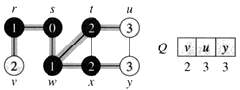
Second Step: It will retrieve one element from the queue and mark the fetched element as Black and will push its adjacent elements to the queue marking them as grey.
bfs2  \
here as you can see, s has been deleted from the queue and now marked as black. Adjacent element of s i.e. w and r are added to the queue.
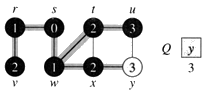
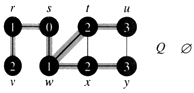
Next: Second step will be followed till queue do not have any more elements. At each vertex level the distance of the vertex is also stored.
bfs9
 bfs3
 bfs4
bfs5
bfs6
bfs7
bfs8
Pseudo Code
Step 1: Assign white color to all the vertices, infinite for each vertex and to make it a tree it is necessary to have parent information, assign parent vertex as null to all vertices.
Step 2: Add source to the queue. Assign distance 0. Change the color of the source as grey.
Step 3: Retrieve first element from the queue. Mark the retrieved element as black.
    1. Find all the adjacent white vertices of the retrieve vertex.
    2. Mark them grey.
    3. Set the distance of the adjacent vertices to one more than the distance of existing vertex.
    4. Add them to queue.
Step 4: Repeat the step 3 until queue is empty.
Pseudo Code in programmatically
   1: BFS(G,s)
   2:  
   3: for each vertex u in V[G] - {s}
   4:     do  color[u] = white
   5:         dist[u] = inf
   6:         parent[u] = nil
   7:         
   8: color[s] = G
   9: dist[s] = 0
  10: parent[s] = nil
  11: Q.add(s)
  12:  
  13: while( Q is empty){
  14:     
  15:     do     u = delete(Q){
  16:         for each v in adj[u] {
  17:             
  18:             do if color[v] = w {
  19:                 
  20:                 color[v] = G
  21:                 parent[v] = u
  22:                 dist[v] = dist[u] + 1
  23:                 Q.add(v)
  24:                 
  25:             }
  26:             
  27:         }
  28:     }
  29:     
  30:     color[u] = B
  31:     
  32: }
Java Code
There is the Java code for the pseudo code mentioned above. I do not think there is need to explain this here.
   1: import java.util.HashMap;
   2: import java.util.List;
   3: import java.util.Map;
   4: import java.util.Queue;
   5: import java.util.Set;
   6: import java.util.concurrent.SynchronousQueue;
   7:  
   8:  
   9: public class BFS {
  10:  
  11:     Map<String, List<String>> graph;
  12:     BFTNode sourceNode;
  13:     Map<String, BFTNode> tree = new HashMap<String, BFTNode>();
  14:     
  15:     BFS(Map<String, List<String>> g, String source){
  16:         graph = g;
  17:         sourceNode = new BFTNode(source);
  18:     }
  19:     
  20:     void createBFTNodes(){
  21:         Set<String> vertices = graph.keySet();
  22:         for(String vertex : vertices){
  23:             tree.put(vertex, new BFTNode(vertex));
  24:             
  25:         }
  26:     }
  27:     
  28:     void algorithm(){
  29:         
  30:         createBFTNodes();
  31:         sourceNode.setColor(1);
  32:  
  33:         Queue<BFTNode> Q = new SynchronousQueue<BFTNode>();
  34:         Q.add(sourceNode);
  35:  
  36:         do{
  37:             
  38:             BFTNode node = Q.remove();
  39:             List<String> adjacentVertices = graph.get(node.getVertex());
  40:             
  41:             for(String adjacentVertex : adjacentVertices){
  42:                 
  43:                 BFTNode temp = new BFTNode(adjacentVertex);
  44:                 temp.setColor(1);
  45:                 temp.setDist(node.getDist() + 1);
  46:                 temp.setParent(node);
  47:                 Q.add(temp);
  48:                 tree.put(adjacentVertex, temp);
  49:                 
  50:             }
  51:             
  52:             node.setColor(2);
  53:             tree.put(node.getVertex(), node);
  54:             
  55:         }while(Q.size() > 0);
  56:         
  57:     }
  58:  
  59: }
  60:  
  61: //This class has getter/Setter method for all the property that a tree node require.
  62: class BFTNode{
  63:     
  64:     private int dist = 0;
  65:     private int color = 0;
  66:     private BFTNode parent = null;
  67:     private String vertex = "";
  68:     
  69:     public BFTNode(String name) {
  70:         vertex = name;
  71:     }
  72:     
  73:     public String getVertex() {
  74:         return vertex;
  75:     }
  76:  
  77:     public int getDist() {
  78:         return dist;
  79:     }
  80:  
  81:     public void setDist(int dist) {
  82:         this.dist = dist;
  83:     }
  84:  
  85:     public int getColor() {
  86:         return color;
  87:     }
  88:  
  89:     public void setColor(int color) {
  90:         this.color = color;
  91:     }
  92:  
  93:     public BFTNode getParent() {
  94:         return parent;
  95:     }
  96:  
  97:     public void setParent(BFTNode parent) {
  98:         this.parent = parent;
  99:     }
 100:  
 101:     public boolean equals(Object anotherObject){
 102:         if (anotherObject instanceof BFTNode){
 103:             return vertex.equals(((BFTNode)anotherObject).vertex);
 104:         }
 105:         return false;
 106:     }
 107:  
 108:     public int hashCode(){
 109:         return vertex.hashCode();
 110:     }
 111:     
 112:     public String toString(){
 113:         if(parent != null)
 114:             return ("Vertex:" + vertex + " Color:" + color + " Dist:" + dist + " Parent:" + parent.vertex);
 115:         else
 116:             return ("Vertex:" + vertex + " Color:" + color + " Dist:" + dist + " Parent: Null");
 117:     }
 118: }
Analysis
It is always mandatory to know how is the performance and resource utilization of the algorithm.
Time taken for the algorithm is O(V+E). This algorithm has linear time complexity which particularly depends upon the sum of the vertices and edges of the graph.
Other Algos implementing this algorithm internally
  1. Dijkstra’s Single Source Shortest Path Algorithm
  2. Prim’s Minimum Spanning tree Algorithm
Disclaimer: All the material here is the result of research and understanding of other material. If there is some content which is either incorrect or inappropriate to the context of the article I am always open for discussion.