Showing posts with label Data Structures. Show all posts

Friday, December 25, 2015

Amazon Interview 1: Problem 2

Problem 2: Given two linked lists. Each node stores a single digit. Each linked list this way represents a decimal number, with number of digits = number of nodes in the list. You need to add them to produce a third list which represents the sum of the numbers.

Problem statement would be complete only if we know the how decimal numbers are represented in the list.


To represent .123 the list is 1 -> 2-> 3


To add 2 numbers, you must consider the following scenario:


List 1 = 4 -> 5 -> 6

List 2 = 6 -> 9

Returned list should be 1 -> 1 -> 4 -> 6 (Though if this is considered only decimal number, it would be incorrect) but for time being let's consider this as a solution.


Solution 1: Modify the shorter list to append the '0' (Zero) to make both the lists size equal. For each list reach to ith location (1 <= i <= N ) starting from the Size of the list and add both the lists. If sum is greater than one use carry to add (i - 1) position.


List 1 => 4 -> 5 -> 6

List 2 => 6 -> 9 -> 0

When I = 3 (Iteration to reach 3rd position = 3)

List 3 => 6
Carry = 0

When I = 2 (Iteration to reach 3rd position = 2)

List 3 => 4 -> 6
Carry  = 1

When I = 1 (Iteration to reach 3rd position = 1)

List 3 => 1 -> 4 -> 6
Carry = 1

Exit the loop and add carry to list 3

List 3 => 1 -> 1 -> 4 -> 6

Time Complexity: 3 + 2 + 1 (N = 3)

Time Complexity for N elements: N + (N-1) + .... + 1 = N(N+1)/2 = O(N*N)

Time complexity of the above solution is O(N*N)


Solution 2: You can even reverse the lists and add them simply. But reversing the list would also require O(N*N) time complexity, and you would change the original structure of the input which is not desirable.


Solution 3: Here is another idea which performs better in normal circumstances, whereas in worst case it has same O(N*N) time complexity.


Logic
 method add start
  input list1 and list2
  minLength = find the smaller length of both the list
  assign a boolean array of len = minLength
  create a node with sum of list1 and list 2 digit mod 10
  array[0] = assign true if sum is greater than zero
  repeatTill = array[0] == true? 0:-1;
  for element from 1 to min length
   create a node with sum of list1 and list 2 digit mod 10
   array[element] = assign true if sum is greater than zero  
   repeatTill = array[element] == true? element:repeatTill;
  end for
  assign the remaining elements of the longer list to new list
  call recursive method to update the carries
 end
 
 method updateCarries start
  input list3, boolean[] array, repeatTill
  if repeatTill is negative then
   return list3
  end if
  if array[0] is true then
   add Node with digit 1 at front of the list
  end if
  for element from 1 to repeatTill
   if array[element] is true then
    assign repeatTill if array[element-1] is true
    update values
   end if
  end for
  return call updateCarries
 end


This solution's best case is O(N) when there is no carry in these two digits. For Example when 123 and 234 are added. In this case, loop is iterated only once.

Whereas in the worst case it will run for O(N*N). That would be most unusual addition. For Example when 9999 and 0001 are added. In this case, N*(N+1)/2 elements are accessed.

Java code for the solution is as following:

Java Code
import java.io.BufferedReader;
import java.io.IOException;
import java.io.InputStreamReader;

/**
 * Problem: Given two linked lists. Each node stores a single digit. Each linked
 * list this way represents a decimal number, with number of digits = number of
 * nodes in the list. You need to add then to produce a third list which
 * represents the sum of the numbers.
 * 
 * E.G. LinkedList 1 -> 2 -> 6 LinkedList 3 -> 8
 * 
 *
 */
public class SumDecimal {

 /**
  * This method reads the input and prepares the array and call the relevant
  * method.
  * 
  * @param args
  * @throws IOException
  */
 public static void main(String[] args) throws IOException {

  BufferedReader br = new BufferedReader(new InputStreamReader(System.in));
  String line = br.readLine();
  /**
   * N is the number of test cases.
   */
  int N = Integer.parseInt(line);
  for (int i = 0; i < N; i++) {
   String[] list1Values = br.readLine().split(" ");
   String[] list2Values = br.readLine().split(" ");
   Node list1 = null;
   for (int index = list1Values.length - 1; index >= 0; index--) {
    Node n = new Node(Integer.parseInt(list1Values[index]));
    n.next = list1;
    list1 = n;
   }
   Node list2 = null;
   for (int index = list2Values.length - 1; index >= 0; index--) {
    Node n = new Node(Integer.parseInt(list2Values[index]));
    n.next = list2;
    list2 = n;
   }
   Node list3 = add(list1, list2);
   System.out.println(list3);
  }
 }

 private static Node add(Node list1, Node list2) {
  int minLength = 1;
  Node l1 = list1;
  Node l2 = list2;
  while (l1.next != null && l2.next != null) {
   minLength++; // M or N whatever is smaller.
   l1 = l1.next;
   l2 = l2.next;
  }
  boolean[] carries = new boolean[minLength];
  Node list3 = new Node((list1.digit + list2.digit) % 10);
  Node list = list3;
  carries[0] = (list1.digit + list2.digit) / 10 == 0 ? false : true;
  int toMove = carries[0] ? 0 : -1;
  for (int index = 1; index < minLength; index++) {
   Node n = new Node((list1.next.digit + list2.next.digit) % 10);
   carries[index] = (list1.next.digit + list2.next.digit) / 10 == 0 ? false : true;
   list1 = list1.next;
   list2 = list2.next;
   list3.next = n;
   list3 = list3.next;
   toMove = carries[index] ? index : toMove;
  }
  if (list1.next != null) {
   list3.next = list1.next;
  } else {
   list3.next = list2.next;
  }
  list = updateCarries(list, carries, toMove);
  return list;
 }

 private static Node updateCarries(Node list3, boolean[] carries, int toMove) {
  if (toMove == -1)
   return list3;
  int nextMove = -1;
  Node list = list3;
  if (carries[0]) {
   Node n = new Node(1);
   n.next = list3;
   list = n;
   carries[0] = false;
  }
  for (int index = 1; index <= toMove; index++) {
   if (carries[index]) {
    int sum = list3.digit + 1;
    carries[index - 1] = sum == 10 ? true : false;
    list3.digit = sum % 10;
    carries[index] = false;
    nextMove = carries[index - 1] ? index - 1 : nextMove;
   }
   list3 = list3.next;
  }
  return updateCarries(list, carries, nextMove);
 }

 static class Node {
  int digit;
  Node next;

  Node(int digit) {
   this.digit = digit;
  }

  public String toString() {
   return (next == null) ? digit + "" : digit + " " + next.toString();
  }
 }

}


Input
7
1 2 3
2 3 4
3 4 5
3 4 5
9 9 9
0 0 1
9 0 0
1 9 9
9 8 1
1 2
1 2 6 8 9 6 7 8 9
9
1 2 6 8 9 6 7 8 9
9 8 4 2 1 4 3 8 7

Output
3 5 7
6 9 0
9 9 9
1 0 9 9
1 1 0 1
1 0 2 6 8 9 6 7 8 9
1 1 1 1 1 1 1 1 7 6

If you feel that something is not correct with the solution, let me know. I would try to fix the problem.

Thursday, December 24, 2015

Amazon Interview 1: Problem 1

This is not my interview question. It was conducted for my friend. He cleared his interview. Now I am sharing/solving all the questions asked to him.

Question 1: Given a sorted array of numbers, some of which may be repeating. Find the first occurrence of a given number.

Answer: In this case we use a binary search which is modified a bit to find min or max.

       If Binary search matches, get the minimum element in left subtree.
  Fetch Mid
  Check whether high is lower than low, return
  Element matches again, so check if next left subtree matches.
  Element does not matches, find if right subtree has the same element.
 Remaining is the binary search.

Following is the program for the solution
import java.io.BufferedReader;
import java.io.IOException;
import java.io.InputStreamReader;

/**
 * Problem: Given a sorted array of numbers, some of which may be repeating.
 * Find the first occurrence of a given number.
 * 
 * E.G. 1, 2, 2, 4, 8, 9, 10, 10, 10, 12
 * 
 * @author Praveen
 *
 */
public class FindFirstElement {

 /**
  * This method reads the input and prepares the array and call the relevant method.
  * @param args
  * @throws IOException
  */
 public static void main(String[] args) throws IOException {

  BufferedReader br = new BufferedReader(new InputStreamReader(System.in));
  String line = br.readLine();
  /**
   * N is the number of test cases.
   */
  int N = Integer.parseInt(line);
  for (int i = 0; i < N; i++) {
   String[] values = br.readLine().split(" ");
   int[] array = new int[values.length];
   for (int index = 0; index < values.length; index++) {
    array[index] = Integer.parseInt(values[index]);
   }
   String find = br.readLine();
   int element = Integer.parseInt(find);
   System.out.println(findIndexForElement(array, element, 0, array.length - 1));
  }
 }

 /**
  * Solution is to use a modified binary search.
  * 1. If Binary search matches, get the minimum element in left subtree.
  * 2. Remaining is the binary search.
  * @param array
  * @param element
  * @param low
  * @param high
  * @return
  */
 private static int findIndexForElement(int[] array, int element, int low, int high) {
  if (low > high) {
   return -1;
  }
  int mid = (low + high) / 2;
  if (array[mid] == element) {
   return getMin(array, element, low, mid - 1);
  } else if (array[mid] > element) {
   return findIndexForElement(array, element, low, mid - 1);
  } else {
   return findIndexForElement(array, element, mid + 1, high);
  }
 }

 /**
  * Finds the element that it first in the array.
  * Solution:
  * 1. Fetch Mid
  * 2. Check whether high is lower than low, return
  * 3. Element matches again, so check if next left subtree matches.
  * 4. Element does not matches, find if right subtree has the same element.
  * @param array
  * @param element
  * @param low
  * @param high
  * @return
  */
 private static int getMin(int[] array, int element, int low, int high) {
  int mid = (low + high) / 2;
  if (low > high) {
   return high + 1;
  } else if (array[mid] == element) {
   return getMin(array, element, low, mid - 1);
  } else {
   return getMin(array, element, mid + 1, high);
  }
 }

}

This program has been tested with the following test cases:
15
1 2 2 4 8 9 10 10 10 12
12
1 2 2 4 8 9 10 10 10 12
16
1 2 2 4 8 9 10 10 10 12
10
1 2 2 4 8 9 10 10 10 12
2
1 2 2 4 8 9 10 10 10 12
1
1 2 2 4 8 9 10 10 10 12
0
1 2 2 4 8 9 10 10 10 12
9
1 2 2 4 8 9 10 10 12
12
1 2 2 4 8 9 10 10 12
16
1 2 2 4 8 9 10 10 12
10
1 2 2 4 8 9 10 10 12
2
1 2 2 4 8 9 10 10 12
1
1 2 2 4 8 9 10 10 12
0
1 2 2 4 8 9 10 10 12
9
1 2 2 4 8 8 8 8 8 8 8 8 9 9 9 9 9 9 9 9 9 9 9 9 9 9 10 10 10 10 12 12 12 12 12 12 12 12 12 12 12 12 12 12 12 12 12 12 12 12 13 13 13 13 13 13 13 13 13 13 13 13 13 13 13 13 13 13 13 13 13 13 13 13 13 13 13 13 13 13 13 13 13 13 13 13 13 13 13 13 13 13 13 13 13 13 13 13 13
10

If you think that I have still missed something during testing. Suggest me.

Sunday, December 20, 2015

Daily Hunt: Interview Questions #3

As I have been part of rat race to find another Job. It was my 3rd interview with Daily Hunt.. It was mix of data structures and Java. I was asked 3 questions on Data Structures and various other questions related to Java.

Question 1: It is related to Data Structure. You have been given list of integers in an array and an another integer X. It is known that multiplication of 2 integers in the array is equal to X. Find the numbers from the array.

Solution 1: Solution I provided was to have 2 separate arrays. One contains the input as received and another to keep integers as Binary Search Tree.

We will iterate through the array to find the first multiplier, and once we found it we will try to find the remaining multiplier in the BST array. If the number is found is the BST, we found the else otherwise move to another integer in the input array.

Question 2: This question is on the design patterns. Design the coffee vending machine?
Coffee Vending machine is simple machine which are part of offices now a day. If you have to implement the coffee building machine, how would you do it?

Coffee vending machine can have options for various tea and various coffees. So what would be the best approach to design a software for such a coffee vending machine.

Now we have various design patterns available with us. What would be the best one for you?

The answer for the problem is the Decorator Pattern. We would discuss the same in the upcoming post in the details. Though I answered it with Abstract Factory and Abstract Method pattern. :-(

Question 3: Interviewer again moves to DS. An application is receiving the stream of strings. String may contain anagram. Application would need to detect those anagrams in the stream.
It is required to check the stream again to figure out if application has already received the string earlier in the stream to report it to be duplicate. But based on the question, 2 strings are duplicate when both of them are anagram to each other.

Simple answer for the question would be to read the string from the stream and sort the character string. Save the string in the Set, to maintain unique strings. If application tries to add the string in the set and it is already added to the set, set does not add it to array and returns false. In this case, the string can be marked as DUPLICATE.

Let's look at the example:
String a is not duplicate of ton of trings.
[String] => Set will contain {ginrst}
[a] => Set {ginrst, a}
[is] => Set {ginrst, a, is}
[not] => Set {ginrst, a, is, not}
[duplicate] => Set {ginrst, a, is, not, acdeilptu}
[of] => Set {ginrst, a, is, not, acdeilptu, of}
[ton] => Set {ginrst, a, is, not, acdeilptu, of} : No addition as 'not' already exists. It is considered as duplicate string.
[of] => Set {ginrst, a, is, not, acdeilptu, of} : No addition as 'of' already exists. It is considered as duplicate string.
[trings] => Set {ginrst, a, is, not, acdeilptu, of} : No addition as 'ginrst' already exists.

Question 4: So here comes a puzzle. 2 persons are landing on a straight line on a point A and B. Points A and B are not known to each of them. How would they find each other?
This one was interesting puzzle. I did not really have any clue about it. So I requested for the clue. Interviewer said that both the person can move in any direction. But it indicated that one of these two would move like a pendulum. So let's say that A moves but not B. So A moves to his left for half KM and later he moves to his right for 1Km. Next if could not find B yet, he moves to his left for 1.5KM, and so on.

Question 5: Here comes a DB cum Java question. An application has one table which contains only one column and one row. It maintains the user id of the users who are registering to the application. Database can only cater 10 update request per second, but number of user registering each second are 1000. How would you tackle the deadlock in this situation?
Now this was a tricky question. Initially I thought that it is required to look the solution at DB side, but rather the problem could have been solved at java side as well. My first thought was to think in terms of triggers. But triggers can not be the solution for this. Why did I think so? Trigger is a DB operation which will increase the count and save the count to database and return the value. In addition, triggers values are cached as well. It can also be a solution.

Java side we can fire the DB update after certain number of users have been created. So it is possible to maintain a static variable which will have the latest value.

I am now thinking, can we even use volatile or threadlocal variable in this? Please let me know if you have some better answer.

Question 6: What is serialization? Why do we use serialized version id for each class?
Serialization is to persist the Java memory object into file system in the form of file or database. readObject and writeObject methods are used to deserial and serial the object into the file file system.

To achieve serialization, it is required for class to implement Serializable interface.

serialVersionID is maintained to differentiate between 2 different version of classes. It helps loader to identify the class and deserial the specific object based on the version of the class. Serialization has been explained quite well in this blog.
http://exploreriddles.blogspot.in/2014/01/serialization-introduction.html

Question 7: On the deployed tomcat server, you have detected memory leak. How would you find the memory leak?
Okay, I assume that there is no fix to find the memory leak. In this case, we would need to first check in our application if something is possible leak. If it is not, it would be required to fetch the memory profile of the tomcat application and run through the profile to figure out the actual reason for the memory leak.
<!-- Notes to Me --> Learn more about Profiling.

Question 8: An application has a thread pool for 10 threads, but tasks provided to the threads are more than 10. How would you handle the situation programmatically?
Okay, I could not handle last 3 questions quite well. I was not to answer all simple questions of this interview. My assumption was that threadpool handles this scenario at it's own. As soon as, we submit a task to thread pool, it checks if there is any thread which is free. Threadpool assigns the task to the certain thread else if all threads are running, it send the task in the wait status to be notified once ny of the thread becomes free.

I am not an expert. I am also for the solution for the questions stated above. If you know some answers, let me know.

Wednesday, December 9, 2015

Oracle Interview - Telephonic Round - Continues

We did not solve the last problem that I was asked in the interview. So let's put together the solution for the same.
  • Algorithm Problem: A random string is provided to you, you must find the minimum number of elements to be inserted in the string to make it palindrome.
    • String is ABA, then method must return 0.
    • String is ABC, then method must return 2 to form ABCBA.
    • String ABCDA, then method must return 2 to form ABCDCBA.
    • String ASD3D5, then method must return 3 to form AS5D3D5SA.
It has been difficult for me to find the solutions for the problem within the specified timeframe as it requires quite a good understanding to achieve such an efficient answers.

When I first heard the question, I felt that this would round would not be difficult as I thought, as I could come up with the algorithm within some time. But I was wrong. It was not the case there.

First Solution
 public class Palindrome {  
      String element;  
      public Palindrome(final String elem) {  
           element = elem;  
      }  
      public int makePalindrome() {  
           if (element.length() <= 1) {  
                return 0;  
           } else {  
                char[] dst = new char[element.length()];  
                int endIndex = element.length() - 1;  
                int index = 0;  
                element.getChars(0, element.length(), dst, 0);  
                while (dst[index] == dst[endIndex]) {  
                     index++;  
                     endIndex--;  
                }  
                return endIndex - index;  
           }  
      }  
      /**  
       * @param args  
       */  
      public static void main(String[] args) {  
           Palindrome p = new Palindrome("ABCA");  
           System.out.println("Chars to be added are: " + p.makePalindrome());  
      }  
 }  

Oh wow, that's it. But it is really worth the question.

What I did?
I solved for ABA, and it would return 0 but it was not the smallest palindrome. After discussion with interview a bit more, I can to know that this code would really not work for "ASD3D5". It was true, the code did not really work as per the question. Hell broke lose here. Now interviewer is already agitated with the time that I have taken.

I have to rework the solution with the closed mind. Stupid mind was still contemplating me to write some code on the same line, and it was not able to think something different at that time. However I failed the interview at that time only, but it was required for me to find the answer for the questions that are asked.

I tried little more and found the following answer.

Solution 2
It is simple, we have to use the dynamic programming to solve the issue that we have in hand. First we cut the corners of the string. In case of ABCDA, we use string BCD for the dynamic programming. Now we find the maximum number of elements which matches between original string and reversed string. Count of minimum non matching characters are the solution for the puzzle.

1:  package com.oracle;  
2:  import java.util.Collections;  
3:  import java.util.List;  
4:  public class Palindrome {  
5:       String element;  
6:       public Palindrome(final String elem) {  
7:            element = elem;  
8:       }  
9:       public int makePalindrome() {  
10:            if (element.length() <= 1) {  
11:                 return 0;  
12:            } else {  
13:                 char[] dst = new char[element.length()];  
14:                 int endIndex = element.length() - 1;  
15:                 int index = 0;  
16:                 element.getChars(0, element.length(), dst, 0);  
17:                 while (dst[index] == dst[endIndex]) {  
18:                      index++;  
19:                      endIndex--;  
20:                 }  
21:                 String substring = element.substring(index, endIndex + 1);  
22:                 System.out.println("New String is: " + substring);  
23:                 return Math.min(substring.length(),  
24:                           minCharForPalindrome(substring.toCharArray(), 0));  
25:            }  
26:       }  
27:       private int minCharForPalindrome(char[] substringArray, int compare) {  
28:            if(compare > substringArray.length){  
29:                 return compare;  
30:            }  
31:            int count = 0;  
32:            for (int index = compare, last = substringArray.length - 1; 
                   index < substringArray.length; index++, last--) {  
33:                 if (substringArray[index] != substringArray[last]) {  
34:                      count++;  
35:                 }  
36:            }  
37:            count += compare;  
38:            System.out.println("When Compare = " + compare + " Count= " + count);  
39:            return Math.min(count,  minCharForPalindrome(substringArray, ++compare));  
40:       }  
41:       /**  
42:        * @param args  
43:        */  
44:       public static void main(String[] args) {  
45:            Palindrome p = new Palindrome("ABCDEFG");  
46:            System.out.println("Chars to be added are: " + p.makePalindrome());  
47:       }  
48:  }  

This solution is based on the dynamic programming where starting from the first point string is compared with the another string. The solution is general should take O(N*N) time to compute the result.
1:  New String is: ABCDEFG  
2:  When Compare = 0 Count= 6  
3:  When Compare = 1 Count= 7  
4:  When Compare = 2 Count= 6  
5:  When Compare = 3 Count= 7  
6:  When Compare = 4 Count= 6  
7:  When Compare = 5 Count= 7  
8:  When Compare = 6 Count= 6  
9:  When Compare = 7 Count= 7  
10:  Chars to be added are: 6  

1:  New String is: ASD3D5  
2:  When Compare = 0 Count= 6  
3:  When Compare = 1 Count= 3  
4:  When Compare = 2 Count= 6  
5:  When Compare = 3 Count= 5  
6:  When Compare = 4 Count= 6  
7:  When Compare = 5 Count= 5  
8:  When Compare = 6 Count= 6  
9:  Chars to be added are: 3  

Now the problem with the solution is the time complexity. Can we do anything better?

Okay few people says yes. There is one solution which uses Knuth-Morris-Pratt Algo to find the solutions more efficiently.I have not implemented it yet, but I would surely try to implement and understand it. If you have understood the same, please suggest me the same.

Links for the reference are as following:
https://en.wikipedia.org/wiki/Knuth%E2%80%93Morris%E2%80%93Pratt_algorithm
http://stackoverflow.com/questions/18732020/add-the-least-amount-of-characters-to-make-a-palindrome

Hope it helps

Sunday, January 19, 2014

Flipkart Interview 1: Data Structure and Algorithm

It was a telephonic discussion with Flipkart, as per its reputation, its interview throws questions to provide algorithms for them. In the first telecon, I was asked 2 questions (though the interviewer wanted to discuss 3), and those are following 2 questions.

A Binary tree is there, root of the binary tree is provided. It is asked to search a node and find all the nodes that are at a K distance from the tree.
Binary Tree - Not BST
 Consider the tree provided in the figure above.

Root of the tree is A, and it is required to find all the elements at distance 3 from Node D.
Answer should be C, J and K.

Root of the tree is A, and it is required to find all the elements at distance 2 from Node D.
Answer should be A, E, P, Q, R, and S.

Root of the tree is A, and it is required to find all the elements at distance 4 from Node D.
Answer should be T, U, V, F and G.

Solution
It is possible to create the graph where starting node of the graph is D as the starting node of the graph. Search Node along with its path. Create a graph with the help of path that was retained while searching the node, find all the nodes at distance K using BFS.

Algorithm for this as follows:
List 1
Find the element using recursion and store all the elements in a stack.
(Time complexity O(n))
Create the graph such that all the parents, catered in the stacks,
points in the other direction. i.e. D -> B-> A
(Time complexity O log(n) + Space Complexity o(Log n))
Now run the Breadth First Search algorithm to for iterations.
(Time complexity O(n))

Total time complexity for the solution is O(n + log n) = O(k*n) = O(n)
Space Complexity is O(log n). 

Let’s look at the alternative approach, as we have to change the linking, so it might not be feasible to change the DS.
List 2
Find the element using recursion and store all the elements in a stack, 
along with the side of the side of the traversal (Left or Right). 
(Time complexity O(n))
Find all downward elements that are at distance K from the node specified.
For each element pop the stack and maintain a count
From the node popped, find all the elements at (K – count) distance 
at the other side of tree.
End for each 

Let’s write a program for the method mentioned above.
We will need 2 classes for complete DS and solution.
Tree.java
class Tree {  
  char data;
  Tree left;
  Tree right;
  public Tree(char data) {
   this.data = data;
  }
  public char getData() {
   return data;
  }
  public void setData(char data) {
   this.data = data;
  }
  public Tree getLeft() {
   return left;
  }
  public void setLeft(Tree left) {
   this.left = left;
  }
  public Tree getRight() {
   return right;
  }
  public void setRight(Tree right) {
   this.right = right;
  }  
  public String toString(){
   return "" + data;
  }
 }

PathElement.java 
class PathElement {
  int direction;
  Tree node;
  public PathElement(Tree node, int dir) {
   this.node = node;
   direction = dir;
  }
  public int getDirection() {
   return direction;
  }
  public void setDirection(int direction) {
   this.direction = direction;
  }
  public Tree getNode() {
   return node;
  }
  public void setNode(Tree node) {
   this.node = node;
  }
  public String toString(){
   return ("Node:" + node.toString() + " Direction: " + direction  + "\n");
  }
 }
Search the path for element requested, and Keep the PathElement object with the stack.
List 3
 Stack path = new Stack();
 private boolean searchElement(Tree root, char search, int direction) {
  if( root == null ) return false;
  if( root.data == search ){
   path.push(new PathElement(root, direction));
   return true;
  }else{
   path.push(new PathElement(root, direction));
   boolean isInLeftTree = searchElement(root.getLeft(), search, 1);
   boolean isInRightTree = !isInLeftTree? searchElement(root.getRight(), search, 2) : false;
   if(!isInLeftTree && !isInRightTree ){
    path.pop();
    return false;
   }
   return true;
  }
 }
Read the downward element and create for these downward element.
List 4
 private List downwardElements(PathElement elem, int distance) {
  List chars = new LinkedList();
  return readElementAtDistanceK(chars, elem.node, distance);
  //Following method is listed further.
 }
Read the upward elements and add them to the list created above.
List 5
 private List upward(Stack path, PathElement pathElem, int distance) {
  PathElement prevElement = pathElem;
  PathElement element;
  int count = 1;
  List chars = new LinkedList();
  try{
   while( ( element = path.pop() ) != null){
    readElementsInDifferentDirection(chars, element, distance - count, prevElement.direction);
    prevElement = element;
    count++;
   }
  }catch(EmptyStackException ese){
  }
  return chars;
 }

 private List readElementsInDifferentDirection(List chars, PathElement element, int i, int direction) {
  Tree root = element.node;
  if( i == 0 ){
   chars.add(root.data);
  }
  if( direction == 1 ){
   readElementAtDistanceK(chars, root.right, i - 1 );
  }else{
   readElementAtDistanceK(chars, root.left, i - 1 );
  }
  return chars;
 }
Module to Read all the elements at a distance K from a node.
List 6
 private List readElementAtDistanceK(List chars, Tree root, int distance) {
  if( root == null ) return chars;
  if( distance == 0 ){
   chars.add(root.data);
   return chars;
  }
  readElementAtDistanceK(chars, root.left, distance - 1 );
  readElementAtDistanceK(chars, root.right, distance - 1 );
  return chars;
 }
Java representation to call the module is as followed.
List 7
  tp.searchElement(root, search, 0);
  PathElement pathElem = tp.path.pop();
  List<Character> chars = tp.downwardElements(pathElem, distance);
  chars.addAll(tp.upward(tp.path, pathElem, distance));  
  System.out.println("All the Characters:" + chars);
It will contain few generic related warnings and errors, please modify them to compile and run the program.

This approach has space complexity of log(n) and time complexity as defined below.
Search the node and path = O(n) //Worst case scenario.
Search the downward and upward elements = O(n) //Worst case scenario.
Time complexity of algorithm is O(n).

Friday, January 17, 2014

Interview: Java along with Algorithm 3

First F2F was followed with another rounds of F2F. Though first round was 90 minutes long but this round did not last longer than 40 minutes.

  1. How to save key and list of Integers in the HashMap?
  2. How is it possible to reduce the size of this map?
  3. Implement HashMap?
  4. Implement LRU with the help of Map?
  5. Find all possible strings of a Given String?
I have got few more interviews lined up for next couple of days. So I will try to remember post those interview question.

In addition to posting new questions, I will surely post the answers these questions.

Interview: Java along with Algorithm 2

After clearing questions in the first round, I was asked to face the interviewer in F2F rounds. I was nervous to face the interviewers after a long long time.

It all started with the general introductory question and followed with the following questions.
  1. Difference between Restful and Soap web services?
  2. What is Soap WS?
  3. Which different XML parsers we have?
  4. Write code for stream parser?
  5. Tell me the class loader heirarchy?
  6. What is serialization?
  7. What is SerialVersionUID?
  8. How does Hashmap work?
  9. What are the differences between SynchronizedHashMap and ConcurrentHashMap?
  10. Implement stack using 2 queues?
  11. Implement stack using 1 queue?
  12. Sort an array containing numbers 0,1,2?
  13. Difference between abstraction and encapsulation?
  14. where will you categories the private method?
  15. How to stop subclass from serializing if super-class is serializable?
I will try to post answers to following question within some time.

Wednesday, October 31, 2012

LinkedList

As we were discussing Data structures earlier. So to continue the discussion on the same topic we will specific data structure in this post.

In this post we are planning to put some light on LinkedList. We will discuss various type of LinkedList and their implementation in Java. Lets get going to understand the simplest, but the most important data structure.

What is LinkedList?
LinkedList is list of objects linked with each other. It is collection of object which can be accesses only in sequential manner.
Sounds nice, but I did not know what you mean.

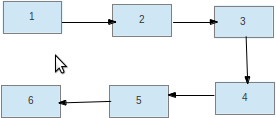
As shown in the figure 1, 2, 3, 4, 5, and 6 are the elements. These elements are stored in a linked list. So to reach to 6 is not possible starting from 1 and traversing throw each of the nodes. Only information about the linked list stored is head of the list. if Link two nodes are broken than  it is not possible to accessible another node.
As shown in the figure 1, 2, 3 are accessible from the header but rest link is lost as there is no link between 3 and 4.

LinkedList representation on Java
As shown above a Node contains data and reference to another node. So if we need to think about the fields of a linked list, then Java class for linked list must be as mentioned below.

class LinkedList{
    int data;
    LinkedList next;
}

As mentioned each node contains the data and reference of another instance of the same class.

Imp Note: None of the programs listed below checks boundary conditions. While writing any program make sure to take them in consideration.
Operations
Add a data object at head.
Add a data object at tail.
Traverse to X location.
Delete the element at X location.
Search a value.

Add a data object at head: Worst Case O(1)
Create a Node and change Node's next to head. Point to Head to latest Node.


Now set new node next to header, but before doing so change new node's next to null.

addAtFront =>
LInkedList node1 = new LinkedList(19);
node1.next = header
header = node1

Add a Data object at rear: Worst Case O(n)
Instead adding to 19 to 1, add 19 after 6.
addAtRear =>

LinkedList node1 = new LinkedList(19);
while(!header.next == null) header = header.next
header.next = node1

By maintaining another instance object(tail) provides faster addition at rear. In general adding at rear is not so much needed.

Traverse to Xth element Worst Case O(X)
It is simple. You just to maintain traverse through X-1 nodes to reach to Xth element.

for( int count = 0; count < X - 1; count ++ ){
    head = head.next;
}
return head.data

Delete Xth element Worst Case O(X)
To delete Xth element you need to traverse to X-1th element and changing the reference of X-1 element to X+1 element instead Xth element.

for( int count = 0; count < X - 1; count ++ ){
    head = head.next;
}
head.next = head.next.next
Now as you can see 4 was earlier pointing to 5, but in the diagram showed above it is now pointing to 6 instead 5. So any link to 5 has been lost, so it is considered as deleted node.

Search A Value: Worst Case O(n)
Iterate over the linkedlist until you reach to either Null or required value. If you encounter NULL, it means LinkedList does not contain the value. In this case return -1, else return the position.
while( header != null && header.value != VAL ){
  header = header.next;
  count = count + 1;
}
return (header == null)? -1: count;

Many different data structures are implemented using linked list. Keeping link list in mind we must look for answers for these questions.
1.    Reverse a LinkList with single pointer in o(n) time…
2.       Linked List implementation of Queue
3.       Linked List implementation of Stack
4.       Finding the location of the list where loop was started.
5.       Write a function to return Nth node from the end of the linked list
6.       Write a function to swap every second node. [ie - 1->2->3->4->5->| becomes 2->1->4->3->5->|]

Type of Linked List
Singly Linked List
Linked implemented above is singly linked list. In this list traversal is possible only in one direction.

Doubly Linked List
It maintains 2 references to point in 2 directions. One to move forward and another to move backward.

class DoublyLinkedList{
    int data;
    DoublyLinkedList next;
    DoublyLinkedList previous;
}


Circular Linked List
This is another variant of Singly linked list. In this list last element of the list points to the first element of the list.

Thursday, October 25, 2012

Data Structures

Data structures are different ways of storing data. After various years of research many people have come up with the following different kind of DS. These different DS are used based on the requirement. DS is chosen based on the problem.

In this blog we will look at the different structures which are helpful to tackle various computing problem. I have tried to put little information about all DS available, In future I will try to explain each one of them with their various versions. Hope it will help me to understand DS more.

Data Structure Fields Operations Time Complexity Pros Cons Comments


Array MAX_CAPACITY add(index, value) – On the specified index add the value. O(1) Index based Retrieval 1. Fixed Size of Array. Arrays are the oldest and most DS. It is used to implement most of the other datastructures.

index delete(index) – Delete at specified index. O(1)
2. Complex position based insertion

objects[] search(value) – Search the value. O(n)
3. One block Allocation. It is not possible to use scattered memory with arrays


Linked List Node{ Data, nextNode} Insert – Add value at head. O(1) 1. Linear Access 1. Retrieval at any index is slower wrt to Arrays.

head of Node type Delete – Search and delete the value. O(n) 2. Does not need continuous memory locations. 2. Complex to use. Linked list are useful when user is concentrating on insert operation instead index based retrieval.


Search – Search the value. O(n) 3. Size of the list is not fixed.


Stacks MAX_CAPACITY IsEmpty – If CURRENT_INDEX = -1 O(1)

Stacks works on last in first out methodology... Stacks are widely used in computer programming.

CURRENT_INDEX isFull CURRENT_INDEX = MAX_CAPACITY O(1)

Stacks are used to validate compile time programs.

objects[] Push – Insert a object in array. O(1)

Infix/postfix/prefix evaluation is done using stacks.


Pop – removes a object and returns its value. O(1)


Queue MAX_CAPACITY isEmpty – If HEAD = TAIL O(1)

Queue works on First In/First out methodology.

HEAD isFull |HEAD - TAIL| = MAX_CAPACITY O(1)

Queue are used to maintain threads.

TAIL Enqueue – inserting the record at head. O(1)


objects[] Dequeue – Deletng the record from tail. O(1)


Tree Node{ Data, Node1, Node2, Node3 ....} add(value) – Based on property of the tree add the node accordinly. O(log(n)) 1. Insertion is faster than array but slower than linked list. 1. Difficult to maintain the balance of the tree. Trees are used for solving lot of algorithmic problems. It is known as most important and efficient data structure to solve multiple issues.

depth Delete – Search and delete the value. O(n) 2. Searching is faster. 2. Complex and confusion at times.

Leaves – Nodes which do not have any children. Search – Search the value. O(log(n)) 3. Used with lot of different data structures.


Internal Nodes – Nodes having one or more children.

4. Solves lot of problems.


Graph Map of vertices and it's accessible vertices. adjacent(G, x, y): tests whether there is an edge from node x to node y. O(K)

Graphs are generally used for greedy solutions.


neighbors(G, x): lists all nodes y such that there is an edge from x to y. O(K)

Shortest path algorithms.


add(G, x, y): adds to G the edge from x to y, if it is not there. O(K)


delete(G, x, y): removes the edge from x to y, if it is there. O(1)


HashTable objects[] add(value) – Adds the value to the array. O(1) Fast searching operations are performed. Need efficient hashing algorithms, otherwise it can be painful to search objects. It is widely used in Database Indexing and caching operations.

MAX_SIZE delete(value) – Removes the value from the array. O(1) Used when program deals with huge chunk of data.


Search(value) O(1)